
AI Brand Visibility Monitoring · Cross-Border Teams
ChatGPT doesn't mention your brand.
Your competitors are already fixing that.
Citany benchmarks how supported AI engine paths recommend your brand, shows you which sources they trust, and helps your team decide what to fix next.
Product Preview
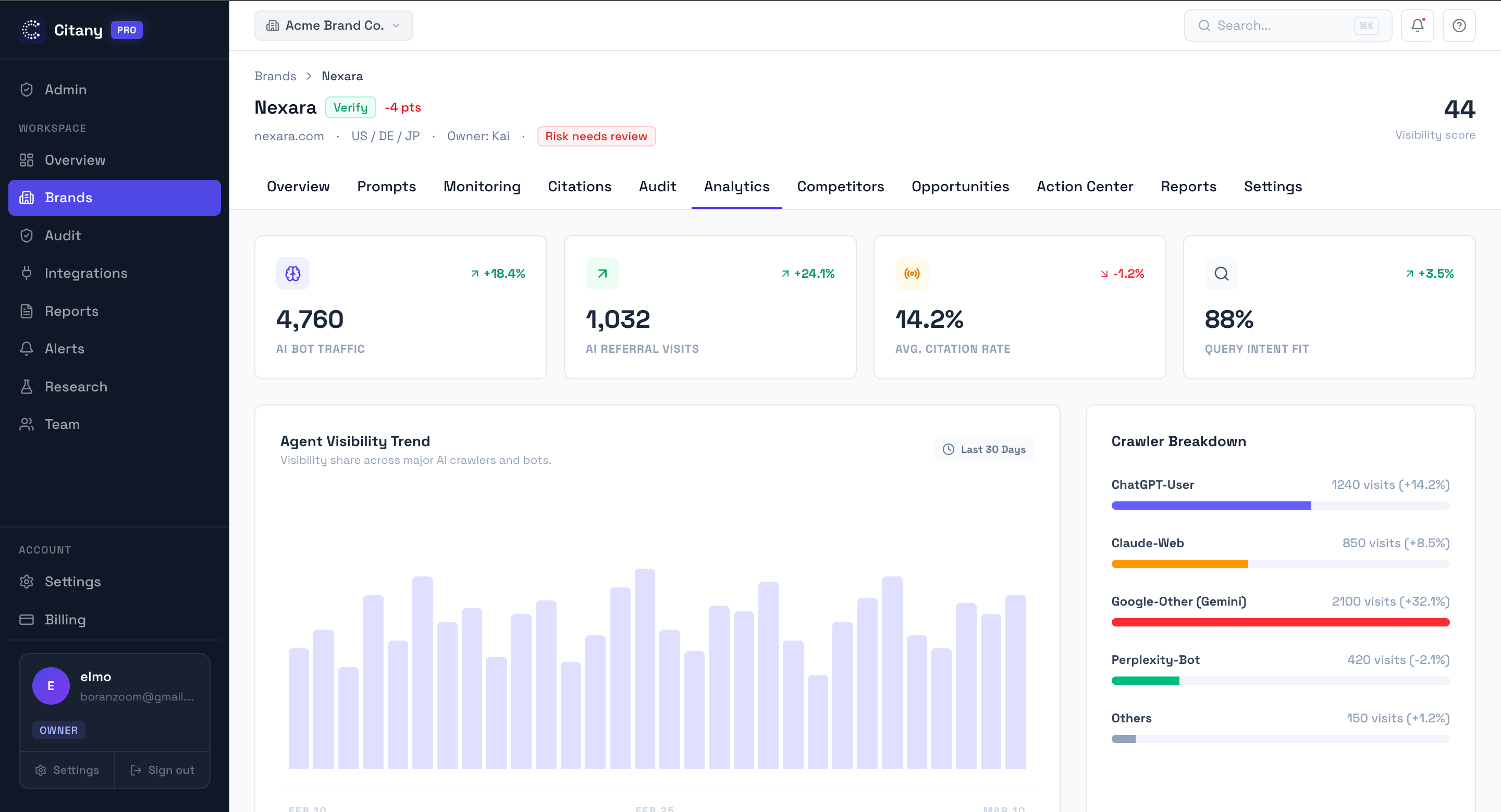
One dashboard. Eight AI engines. Full picture.
Why Citany
8 supported AI engine paths in one workflow.
8
supported engine paths
ChatGPT, Claude, Grok, Gemini, Perplexity, DeepSeek, Kimi, and Doubao
3
baseline paths in Free Audit
Free Audit uses a market-adaptive 3-engine baseline, not a full product trial
5 / 8
Starter vs Pro coverage
Starter covers 5 mainstream paths. Pro and Agency unlock all 8 supported AI engine paths
2 business days
baseline diagnostic SLA
Submit your brand URL and get a one-time AI brand diagnostic delivered by email
Differentiators
Three things no other AI visibility tool gets right
Built to include Kimi and Doubao
Global engines are only part of the picture. Citany includes Kimi and Doubao in the same workflow so cross-border teams can compare supported global and localized engine paths together.
Shows why competitors get cited, not just that they do
Citany surfaces the exact pages, domains, and source types AI engines trust. You see the gap — review site advantage, missing comparison page, weak entity signals — and know what to fix.
Built for cross-border operators, not enterprise analysts
Start with a brand visibility diagnostic. Move into monitoring when you are ready. No 6-month contracts, no $500/month entry tier, no feature walls hiding basic diagnostics.
The Problem
Your Google rankings tell you nothing about what AI recommends
Research from Semrush shows only 8% URL overlap between top Google results and what ChatGPT actually cites. High SEO rankings and low AI visibility can exist at the same time — and standard analytics will never surface this gap.
What teams are flying blind on
1. Submit your brand and competitors
Tell Citany who you are, who you compete with, and which markets you sell into.
2. Monitor supported engine paths
Track brand mentions, answer position, cited sources, and competitor gaps across mainstream and localized engine paths.
3. See why competitors are winning
Citation Intelligence shows the specific pages and domains AI trusts over your own site.
4. Fix what matters, verify it worked
Action Center gives you a prioritized task list. Confirm improvement with the next monitoring cycle.
Platform Modules
Six capabilities that take you from question to action
Every module connects to the next. Research demand, monitor answers, diagnose citations, analyze competitors, fix the gaps, and report what changed.
Prompt Research
Map the queries people actually ask when discovering your category. Find the high-intent prompts your brand is missing — before competitors lock them up.
Multi-Engine Monitoring
Track whether AI mentions your brand, what position it appears in, and which competitors get recommended first — across 8 supported AI engine paths.
Citation Intelligence
See exactly which URLs, domains, and content types AI cites when answering prompts in your category. Understand the source gap, not just the mention gap.
Competitor Gap Analysis
Find the specific prompts where competitors win and you don't. Understand whether they win because of better content, stronger review coverage, or clearer category framing.
Action Center
Convert diagnosis into a prioritized task list: which page to rewrite, which comparison asset to build, which third-party review gap to close first.
Visibility Reports
Generate clean PDF reports showing AI mention trends, citation changes, and action progress — for internal teams or white-label agency delivery.
Market Localization
Localized engine paths change the evidence your brand needs
Kimi and Doubao should not be an afterthought
Most visibility tools are built around mainstream global engines only. For brands with cross-border exposure, that leaves a blind spot in localized engine paths like Kimi and Doubao.
Research Guide
Localized Ecosystems: The AI Visibility Guide
How localized engines select brands, which sources they trust, and what cross-border teams should prioritize.
Playbook
GEO for Cross-Border Brands: The 2026 Playbook
The practical framework for improving brand visibility across both global models and localized AI ecosystems.
Who Uses Citany
Built for teams managing brand visibility across markets
Cross-border brands in localized markets
Monitor how Kimi and Doubao — the localized AI engines dominant in Asian markets — describe your brand, and how it diverges from global model recommendations.
SEO and content teams going beyond Google
Find out which of your pages get cited in AI answers, which competitor pages beat you, and which content gaps are costing you AI recommendation share.
Agencies offering GEO and AEO services
Run free audits to win new clients, benchmark competitors to show gaps, and deliver monthly AI visibility reports — with white-label PDF exports.
Ecommerce operators in competitive categories
Are you being recommended in global and localized buyer journeys? Track brand mentions across 8 search ecosystems.
What You Get
Three outcomes teams ask for before they start
Not vague 'AI optimization scores' — specific answers to questions you actually have.
Know exactly which pages to build or fix first
Instead of guessing between comparison pages, FAQ blocks, and schema work, see the source evidence behind competitor citations and act on the highest-leverage gap.
Uncover gaps in localized search networks
Most brands ignore localized engines. Kimi and Doubao are recommending your competitors to Asian-market buyers right now — find out what they're saying.
Show stakeholders whether the work is improving
Track AI mention rate and citation changes over time. When you publish a new page or build a comparison asset, verify whether the same prompts now recommend your brand more often.
Tool Comparison
How Citany stacks up against other AI visibility tools
Most tools cover global mainstream models only. Citany is built for teams that need both mainstream and localized AI engine paths in the same workflow.
Otterly Alternative
Citany vs Otterly: AI Visibility Tool Comparison for Cross-Border Teams
Comparing Citany and Otterly on AI engine coverage, Chinese market support, pricing, and citation diagnostics. Find out which tool fits cross-border brand monitoring in 2026.
Profound Alternative
Citany vs Profound AI: Mid-Market Alternative for Cross-Border Brands
Profound AI targets enterprise. Citany offers comparable monitoring with localized search ecosystem coverage at a fraction of the price. Full comparison for 2026.
AthenaHQ Alternative
Citany vs AthenaHQ: AI Visibility Platform Comparison for 2026
AthenaHQ is a YC-backed AEO platform at $295/month covering 8 EN engines. Citany covers 8 engines too — but replaces some EN duplicates with Kimi, Doubao, and DeepSeek. Full comparison for cross-border brand teams.
Brand24 Alternative
Citany vs Brand24: AI Search Monitoring vs Social Listening
Brand24 monitors social media mentions. Citany monitors whether AI engines recommend your brand. Different problems, different tools. Full comparison for marketing teams in 2026.
Latest Research
Understand how AI engines select brands and what changes their answers
Research Report
AI Mentioned Your Brand — But Described a Company That Does Not Exist
A monitoring tool showed ✓ Mentioned. The actual AI response described an AutoML platform with GPU/TPU acceleration — a product that does not exist. This is the brand hallucination problem, and it is more dangerous than not being mentioned at all.
Guide
How Compare Pages Capture Competitor Brand Search Traffic
A brand new site with zero authority can rank position 1–6 for competitor brand searches within 72 hours. Here is exactly how compare pages work, why they are one of the highest-ROI SEO moves in a new category, and how to build them properly.
Research Report
What Is Your AI Monitoring Tool Actually Measuring?
Most AI visibility tools call a model API and call it 'monitoring ChatGPT.' That is not the same thing. Here is what each measurement mode actually captures — and why it matters for every claim on your dashboard.
Guide
The 5 Root Causes of AI Search Invisibility
Brands lose in AI search for five distinct reasons — and fixing the wrong one wastes months. A diagnostic framework for understanding exactly why your brand is not getting cited.
Research Report
The Cross-Border AI Visibility Gap: Why You Are Invisible in Kimi and Doubao
A brand can rank #1 in ChatGPT answers while being completely absent from Kimi, Doubao, and DeepSeek. This is not a translation problem. Here is why — and what to do about it.
Research Report
The Hidden Cost of AI Monitoring: Why Search Fees Change Everything
Search-enabled AI engines like Perplexity charge per web search, not just per token. At scale, that changes the entire economics of brand monitoring. A breakdown of real costs across 8 engines.
Research Report
Kimi, Doubao & DeepSeek: The AI Visibility Guide for Asian Markets
Millions of users in distinct search ecosystems use localized models to research purchases every month. Most global monitoring tools miss these. Here is what cross-border brands need to know.
Guide
AEO vs SEO: What's Actually Different in 2026
A practical comparison of Answer Engine Optimization vs traditional SEO. What changed, which metrics matter, and how to build a strategy that wins in both worlds.
Guide
GEO for Cross-Border Brands: The Complete 2026 Playbook
Generative Engine Optimization guide for cross-border sellers and DTC brands. How to get cited by global mainstream models and localized search ecosystems — and measure whether it is working.
Research Report
The Citation War: How AI Search Selects Winners in 2026
A deep-dive into the black-box citation mechanisms of ChatGPT, Perplexity, and Google AI Overviews.
Pricing
Start free. Pay when you need ongoing monitoring.
Free Audit is a separate one-time diagnostic. The actual product ladder starts with Trial, then moves into Starter, Pro, and Agency for ongoing monitoring.
Trial
$0
14-day product trial for teams validating first value on one brand
- 1 brand with up to 2 competitors
- 3 baseline AI engine paths and 80 included responses total
- Manual scans only during the trial period
- Built to validate product fit before upgrading to Starter or Pro
Starter
$49
/per monthSolo founders and single-brand teams
- 1 brand with up to 3 competitors
- 5 mainstream AI engine paths
- Weekly monitoring with email alerts
- 4 reports and 4 exports per month
Pro
$149
/per monthCross-border teams that need integrated search coverage
- Up to 3 brands with up to 5 competitors per brand
- 8 supported AI engine paths
- Daily monitoring, Slack alerts, and full Action Center
- 12 reports and 12 exports per month
Agency
$399
/per monthAgencies managing multiple client accounts
- Up to 10 brands with up to 10 competitors per brand
- 8 supported AI engine paths
- White-label and client-safe exports
- 10 team members included and priority support
FAQ
Common questions before teams start
What AI engines does Citany monitor?
Citany supports 8 AI engine paths: ChatGPT, Claude, Grok, Gemini, Perplexity, DeepSeek, Kimi, and Doubao. Evidence quality varies by engine and measurement mode, so results should be interpreted path by path rather than as eight identical consumer surfaces.
How is Citany different from tools like Otterly, Profound, or AthenaHQ?
Most existing tools cover global mainstream models only. Citany also monitors Kimi and Doubao — the localized AI engines dominant in Asian markets — mapping the unique platform sources (Zhihu, Xiaohongshu) they draw citations from.
What does the free brand audit include?
You submit your brand URL and up to three competitors. Citany runs a one-time, market-adaptive 3-engine baseline diagnostic and delivers a structured report within 2 business days. It is a diagnostic offer, not a product trial.
My Google rankings look fine. Why does AI visibility matter?
Google search and AI search pull from different source ecosystems. Research shows only 8% URL overlap between top Google results and what ChatGPT cites. Ranking well on Google does not mean AI engines recommend your brand — they often cite review sites, directories, and comparison pages that never rank on page one.
Why do localized ecosystems need separate monitoring?
Kimi and Doubao cite completely different platforms than global models — Zhihu, Xiaohongshu, and Douyin instead of Reddit, G2, and LinkedIn. If your brand is invisible in these localized engines, you are missing the AI-driven discovery layer for Asian-market buyers.
Do you manipulate AI prompts to force your brand to appear?
No. Citany measures how AI engines respond to neutral, unbranded category and comparison prompts — the same way a real buyer would phrase them. The goal is honest diagnosis, not manufactured visibility.
If AI keeps citing my competitors instead of me, what do I fix first?
Start with Citation Intelligence — it shows which specific pages and domains AI trusts in your category. Usually the fix is a missing comparison page, a weak review presence, or unclear category language on your own site. Citany's Action Center turns those findings into a specific task list.
Get Started
Find out what AI says about your brand today
Find out what AI says about your brand — for free.
Submit your brand and we'll run a market-adaptive 3-engine baseline diagnostic. It's a one-time offer, not a product trial.